






FAQs
- What does HYDAC‘s nitrogen charging unit do?
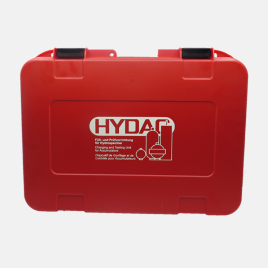
HYDAC‘s nitrogen charging unit charges quickly and cost-effectively, and supplements pre-charge pressure in all standard diaphragm, bladder and piston accumulators and bladder and piston accumulator stations.
Typically, accumulator charging relies on differential pressure between the nitrogen cylinder and the accumulator to allow pre-charging. However, this will not be possible when the residual nitrogen in the cylinder falls below the required accumulator pre-charge pressure.
The nitrogen charging unit allows the low-pressure nitrogen in the nitrogen bottle to be pumped into an accumulator or stored in another cylinder at a higher pressure. This allows the nitrogen bottle to be almost completely evacuated, thereby utilising the nitrogen that would ordinarily be wasted.
Does HYDAC’s nitrogen charging unit come with any pressure guarantee?HYDAC’s nitrogen charging unit guarantees optimum use of commercially available nitrogen bottles up to a residual pressure of 20 bar and a maximum accumulator pressure of 350 bar.
Why do hydraulic accumulators lose their pre-charge over time?Hydraulic accumulators lose their pre-charge pressure over time due to leakage/diffusion from the gas side to the oil side and due to the relieving of pre-charge pressure during periodic inspections or maintenance work, according to HYDAC.
When are additional tools required for pre-charging hydraulic accumulators?According to HYDAC, standard nitrogen bottles generally have a pressure of 200 bar, which means that hydraulic accumulators with a pre-charge pressure greater than 200 bar cannot be pre-charged without additional tools (poor utilisation of the nitrogen bottle is the result for even lower pre-charge pressures as a relatively high residual pressure normally remains).
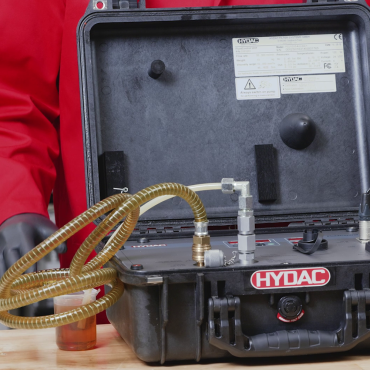
What makes up a nitrogen charging unit?A HYDAC nitrogen charging unit consist of an oil supply unit with a downstream piston accumulator that serves as a compressor for the nitrogen. A digital display allows the desired pre-charge pressure to be set and the charging process to be started.
When does a nitrogen charging unit’s charging process end?A HYDAC nitrogen charging unit’s charging process ends automatically once the set pre-charge pressure is reached.
What applications are suited to a nitrogen charging unit?HYDAC’s nitrogen charging unit product range is suited to diverse applications and includes mobile, portable, stackable and stationary model versions in various pressure and charging-speed levels. For more detailed information contact HYDAC.
When should a pressure reducing valve be used in connection with a nitrogen charging unit?A pressure reducing valve should be used when the pressure in the nitrogen bottle is greater than the permitted operating pressure of the hydraulic accumulator, according to HYDAC.
Where should a pressure reducing valve be installed?A pressure reducing valve should be installed at the nitrogen bottle directly and set to the permitted operating pressure of the hydraulic accumulator to be charged, according to HYDAC.